Independent MSc Conservation thesis · Hefei · 2024-2025
Revitalization and Vibrancy in Historic Districts
A mixed-method study of how the revitalization of Hefei City God Temple reshaped cultural, social and economic vibrancy - and why a cleaner, better-equipped district can still lose parts of its everyday life.
01
Overview
Context and purpose
Historic-district revitalization is often judged by visible upgrades. I examined a harder question: did the project also sustain the cultural practices, social relationships and local economy that made the district vibrant? Using Hefei City God Temple as the primary case, I built a three-dimensional assessment framework and combined spatial, social-media, archival and stakeholder evidence to evaluate both gains and trade-offs.
My contribution
What I was responsible for
- 01
Defined vibrancy as a cultural, social and economic question, then translated it into a nine-indicator assessment model.
- 02
Designed and carried out an explanatory sequential mixed-methods study using 80+ questionnaires and 10 semi-structured interviews with residents, visitors and workers.
- 03
Combined QGIS mapping, POI data, historic images, field observation, policy and archival research, and Dianping review analysis.
- 04
Compared Hefei with Nanjing Confucius Temple, Shanghai City God Temple and Xi’an Capital City God Temple to separate transferable lessons from local conditions.
- 05
Turned the evidence into four practical directions: protect living heritage, retain room for informal activity, strengthen participation, and support inclusive local economies.
02
Process & evidence
Background: a renewed district that felt less alive
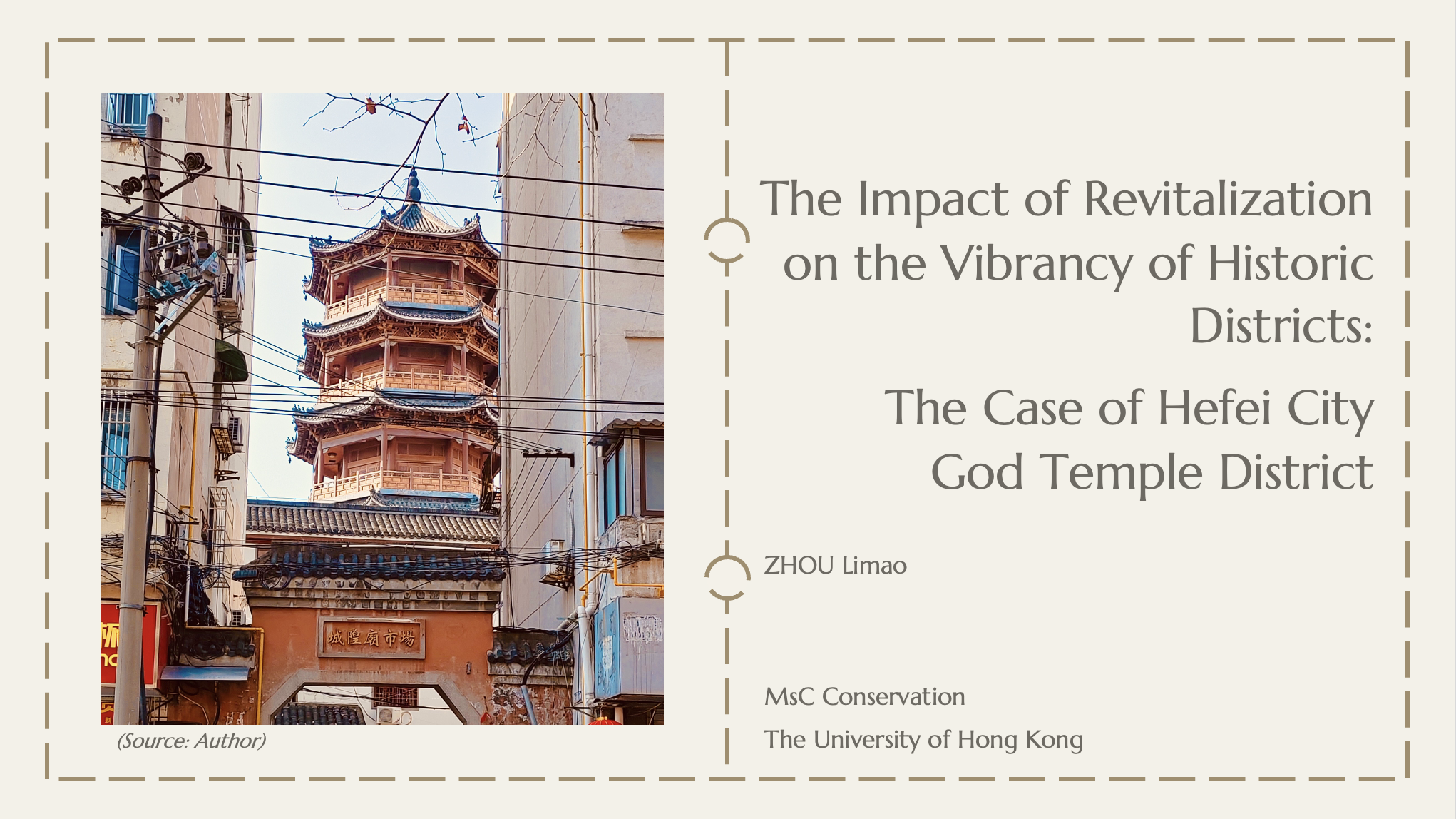
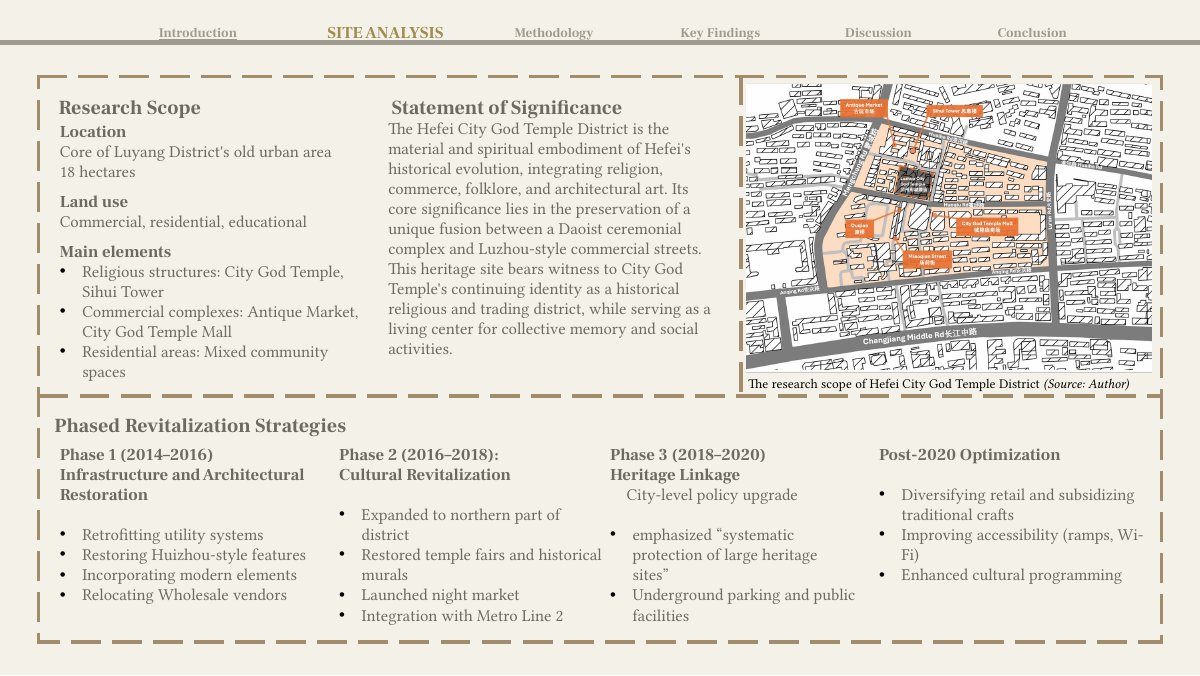
Hefei City God Temple is an 18-hectare historic district in the old centre of Luyang. It combines a Daoist ceremonial complex, commercial streets, housing and public life. Since 2014, phased revitalization improved infrastructure, restored architectural features, reorganized commerce and introduced cultural programmes. Yet visible improvement did not settle the question of success: traders had been relocated, informal gathering places had disappeared, and local users often described the district as cleaner but quieter. This tension made the site a useful case for asking what revitalization preserves, what it changes, and whose experience counts.
03
Process & evidence
Research framing: looking beyond physical renewal
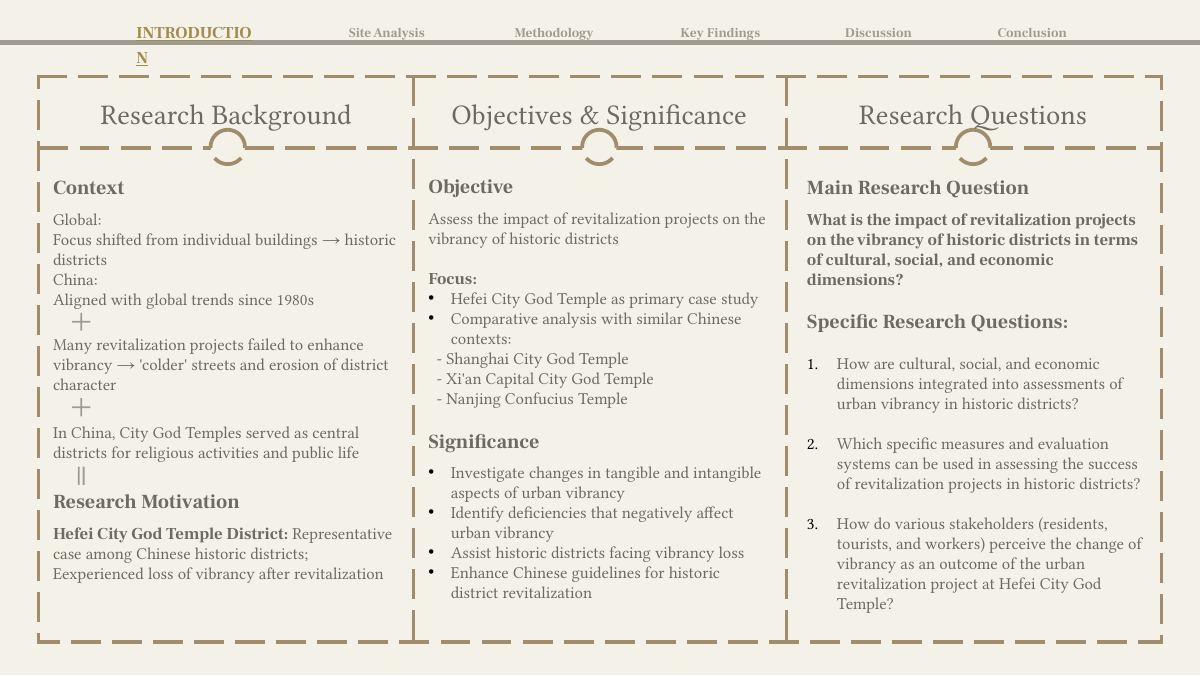
I reframed the project from a design-quality review into an impact assessment. The main question was how revitalization affected cultural, social and economic vibrancy. Three supporting questions asked how those dimensions could be integrated, which measures could make success assessable, and how residents, visitors and workers perceived change differently. This framing mattered because it prevented the research from treating a restored facade or upgraded street as a complete outcome. It also created a clear route from an abstract concept - vibrancy - to evidence that could inform future projects and policy.
04
Process & evidence
Process: quantitative patterns first, qualitative explanation second
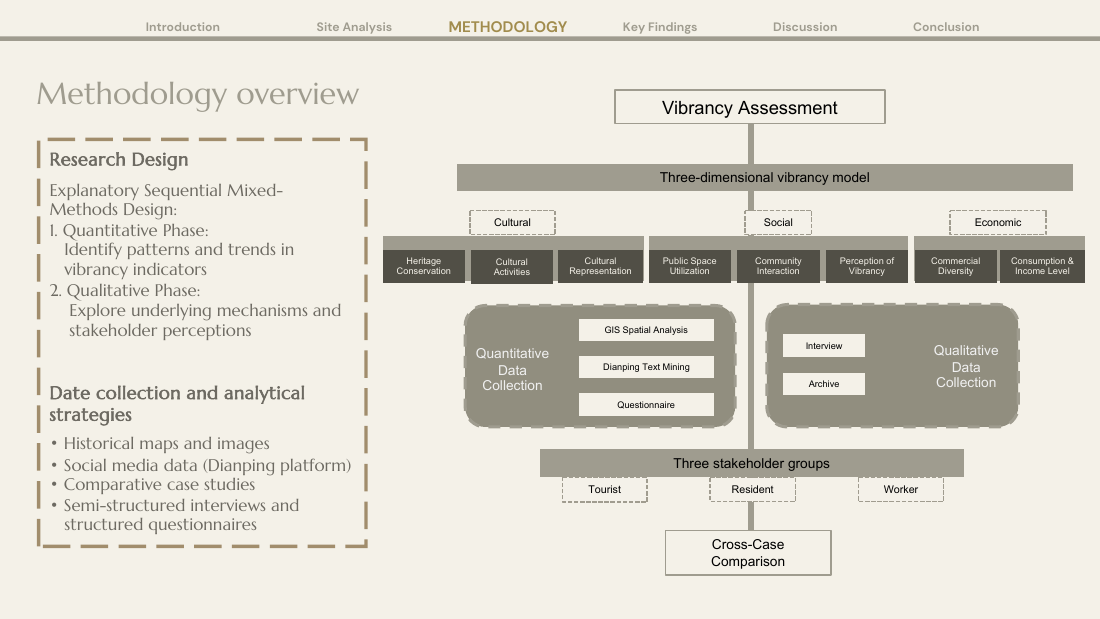
I used an explanatory sequential mixed-methods design. Quantitative evidence first identified patterns in spatial structure, commercial distribution, online language and stakeholder ratings. Qualitative evidence then helped explain the mechanisms behind those patterns: what people missed, why some improvements mattered to residents, and how rents or management rules affected workers. Triangulation across maps, field observations, historic images, policy records, questionnaires, interviews and Dianping reviews reduced reliance on any single source. DeepSeek was used only to improve language; I reviewed and edited the text and remained responsible for the research evidence and conclusions.
05
Process & evidence
Key decision: build a three-dimensional assessment model
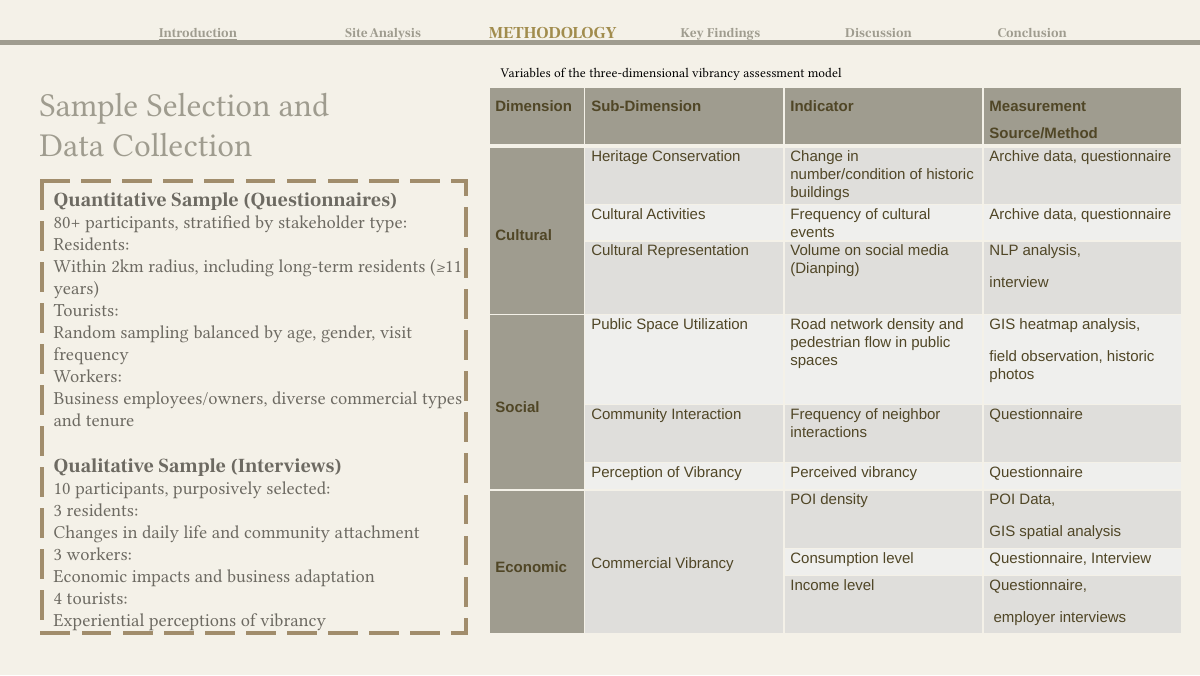
A key design decision was to make vibrancy measurable without reducing it to footfall. I organized nine indicators under three dimensions. Cultural vibrancy covered heritage conservation, cultural activities and cultural representation. Social vibrancy covered public-space use, community interaction and perceived vibrancy. Economic vibrancy covered commercial diversity, consumption and income. Each indicator was paired with an appropriate source or method, from archives and questionnaires to GIS, interviews and social-media analysis. The model gave the thesis a consistent structure and made conflicting outcomes visible rather than forcing them into one success score.
06
Process & evidence
Key decision: keep stakeholder differences visible
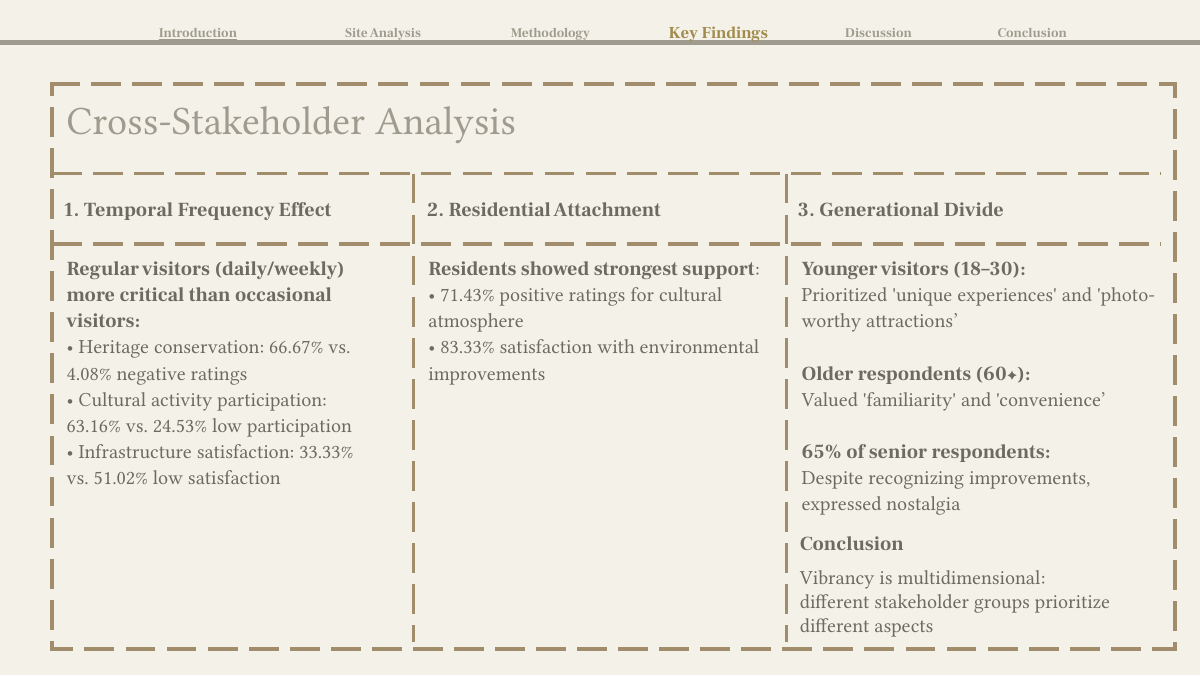
Rather than treating public opinion as a single average, I separated residents, visitors and workers, then examined visit frequency and age. The study used 80+ questionnaires and 10 semi-structured interviews. This revealed that regular users were often more critical than occasional visitors, residents were most positive about safety and environmental improvements, and older participants placed greater value on familiarity and convenience. The decision made the analysis more useful for management: the same intervention can benefit one group while weakening the everyday practices of another.
07
Process & evidence
Finding 1: stronger visual identity, weaker living culture
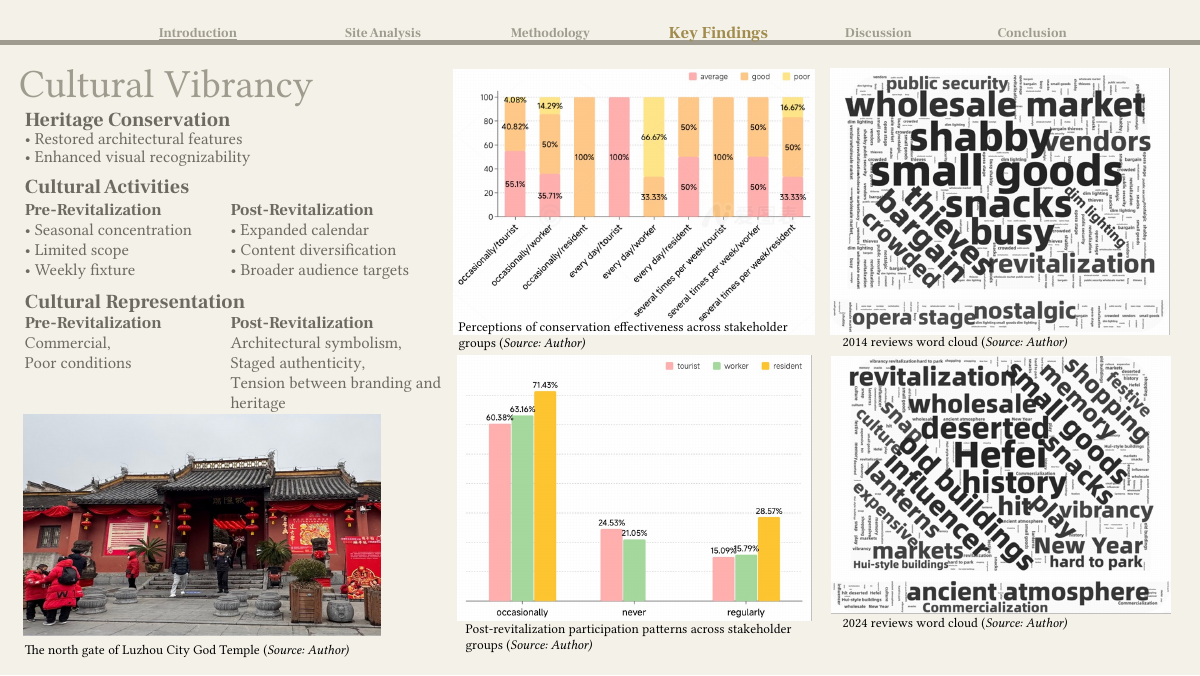
Architectural restoration improved the district’s visual recognizability, and the post-revitalization calendar included more festivals, markets and performances. But participation remained uneven, and the content did not always reinforce Hefei’s own traditions. Dianping reviews shifted from references to wholesale trade and poor conditions toward Huizhou-style architecture, photo opportunities and seasonal atmosphere. Interviews also pointed to homogenized shops and the replacement of specialist markets and crafts. The finding was not that cultural programming had failed, but that visible symbols and scheduled events could not by themselves sustain everyday cultural continuity.
08
Process & evidence
Finding 2: order improved, spontaneity contracted
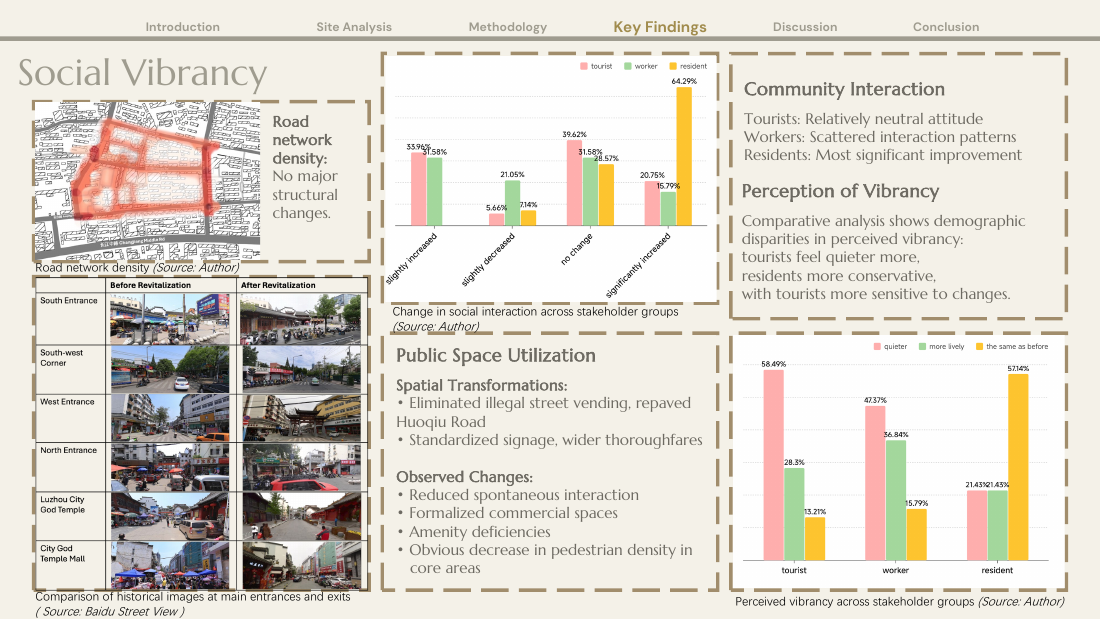
Road structure changed little, but repaving, standardized signage and the removal of informal vending produced wider and more orderly routes. Residents reported stronger neighbourhood interaction and valued improved lighting and safety. At the same time, historic-image comparison and interviews indicated fewer places to sit, trade or talk informally, especially for older residents and long-term workers. Tourists and workers were also more likely than residents to describe the district as quieter. The evidence shows that formal order and social vibrancy are not the same: a well-managed space still needs settings where unplanned everyday interaction can happen.
09
Process & evidence
Finding 3: redistributed commerce, uneven benefits
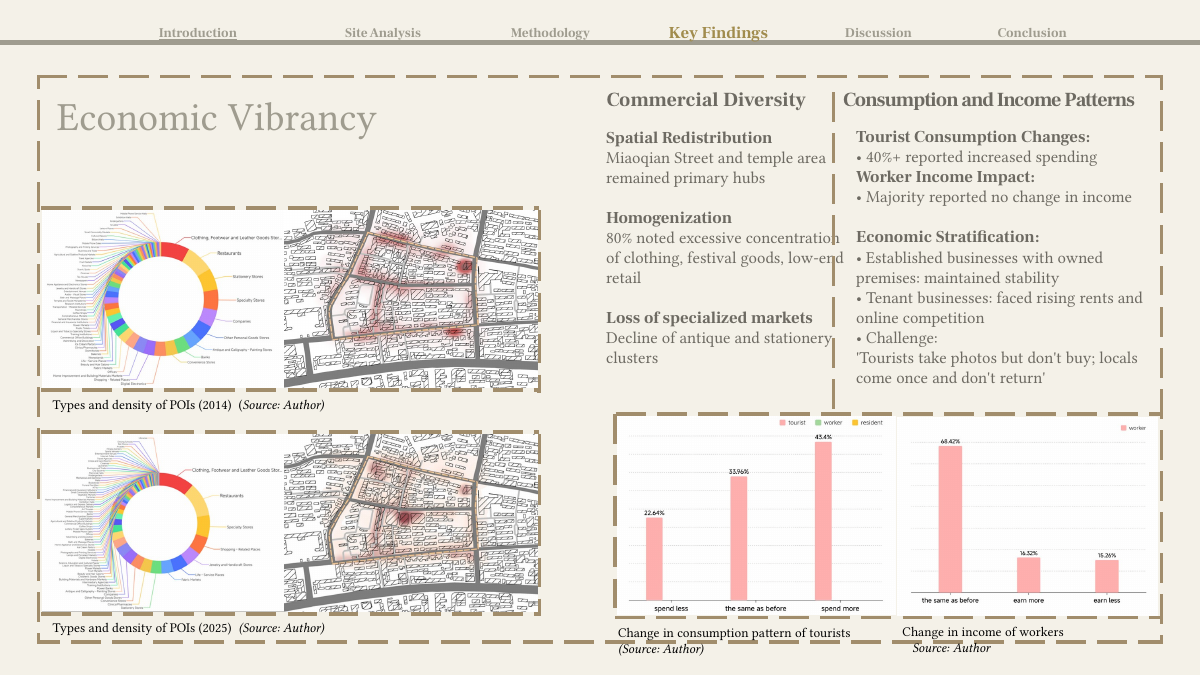
POI mapping showed commercial activity spreading beyond the original concentration around Miaoqian Street, while the temple area remained a major hub. More than 40% of surveyed visitors reported higher spending, but 68.42% of workers reported no income change. Interviews exposed a sharper divide: businesses that owned their premises were more stable, while tenants faced rent increases and online competition. Many participants also perceived an excessive concentration of clothing, festival goods and low-end retail. The revitalization expanded and reorganized commerce, but did not guarantee a resilient or inclusive local economy.
10
Process & evidence
Key decision: compare strategies, not copy solutions
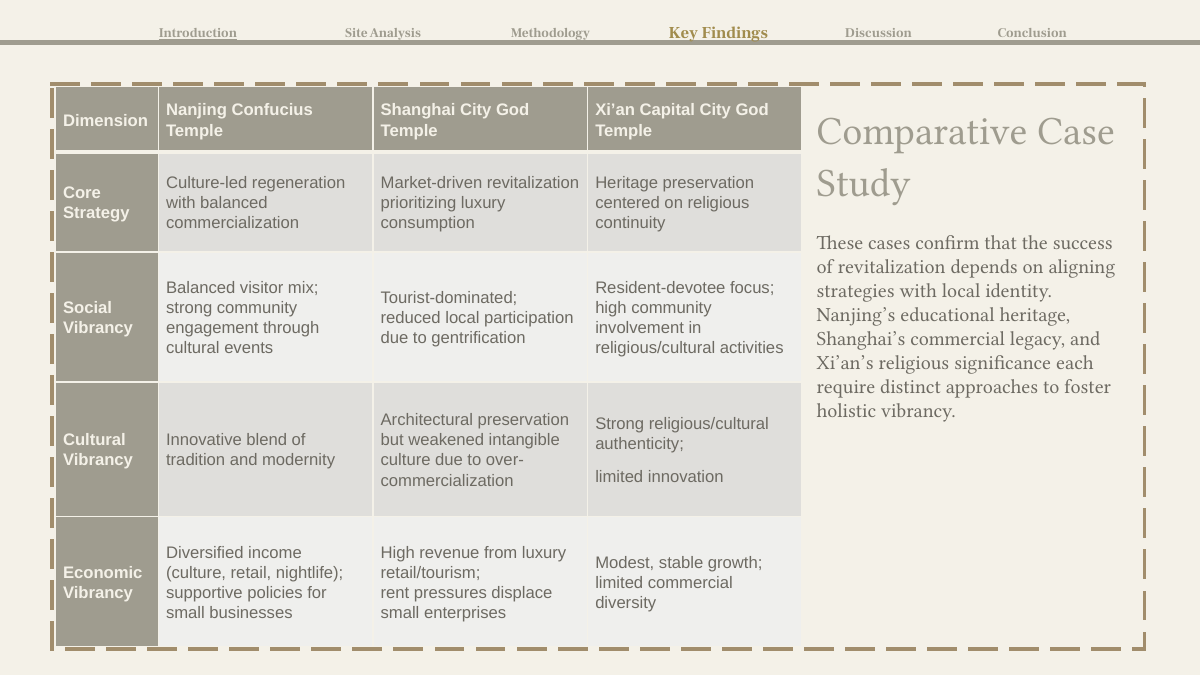
I compared Hefei with three historic districts that followed different paths: Nanjing Confucius Temple’s culture-led and mixed-use approach, Shanghai City God Temple’s market-driven tourism model, and Xi’an Capital City God Temple’s emphasis on religious continuity and community involvement. The comparison was used to test explanations, not to rank the cities. It showed that the same intervention can produce different results depending on local identity, governance and economic structure. The transferable lesson was therefore a decision principle: align revitalization with the district’s own cultural role and stakeholder needs before selecting design or commercial measures.
11
Process & evidence
Synthesis: the hardware-upgrade paradox
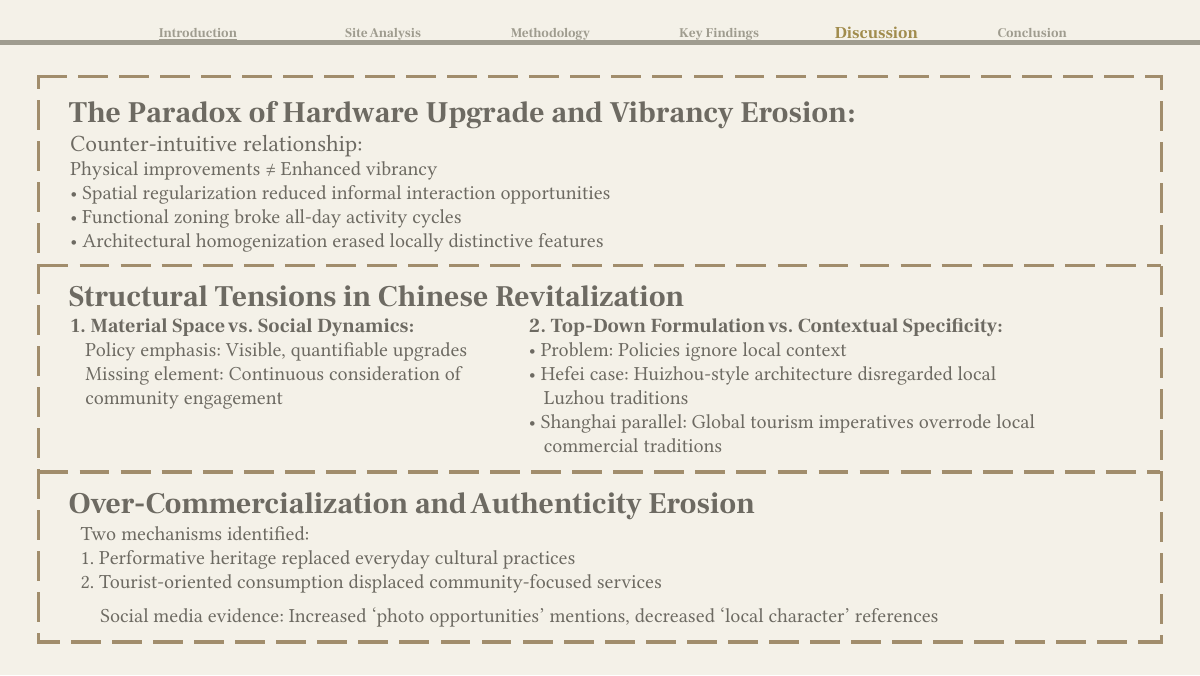
The evidence converged on a central paradox: physical improvements can solve congestion, safety and maintenance problems while weakening the complexity that made a place lively. In Hefei, spatial regularization reduced opportunities for informal interaction; functional separation interrupted all-day activity; and standardized architectural language risked replacing local Luzhou character with generic imagery. Commercial growth also created pressure on community-serving businesses. I connected these effects to a policy-practice gap: visible and quantifiable upgrades are easier to deliver, but long-term cultural continuity, social relationships and local livelihoods require ongoing management rather than a one-time construction project.
12
Process & evidence
Outcome: four directions for future revitalization
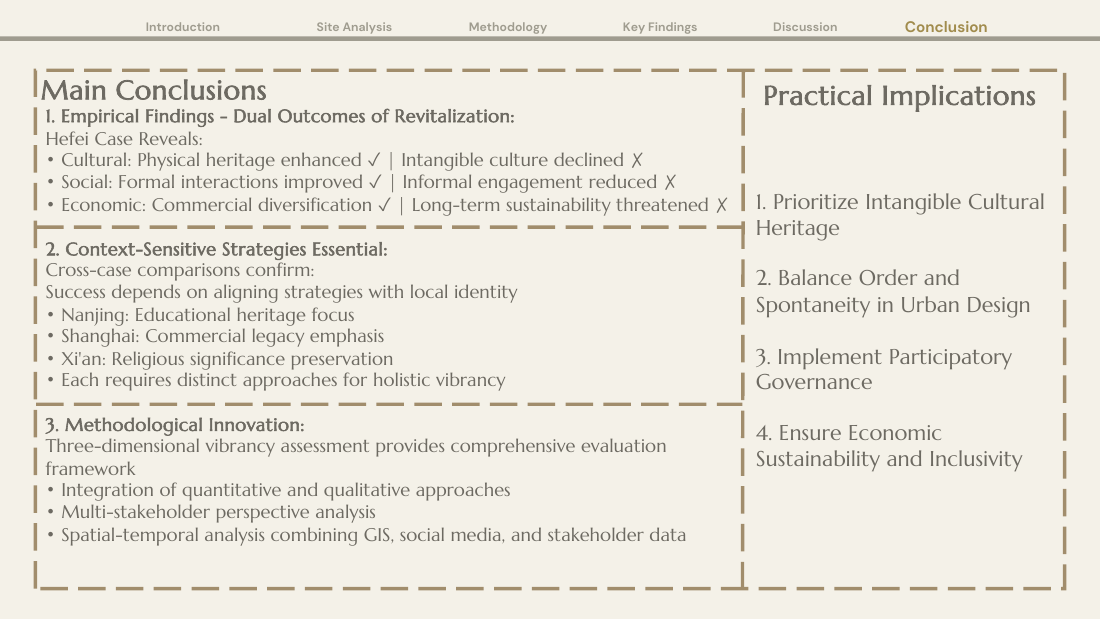
The thesis translated analysis into four practical directions. First, support living heritage through traditional crafts and community-led cultural activity. Second, balance order with spontaneity by retaining informal gathering, vending and pocket spaces. Third, use information disclosure and public consultation to connect top-down plans with local knowledge. Fourth, protect economic inclusion through rent regulation and support for local and traditional businesses. Alongside these recommendations, the research produced a complete 77-page thesis, a defense presentation, a reusable three-dimensional assessment framework, maps, charts and a documented set of research instruments.
13
Process & evidence
Reflection: what the evidence cannot yet answer
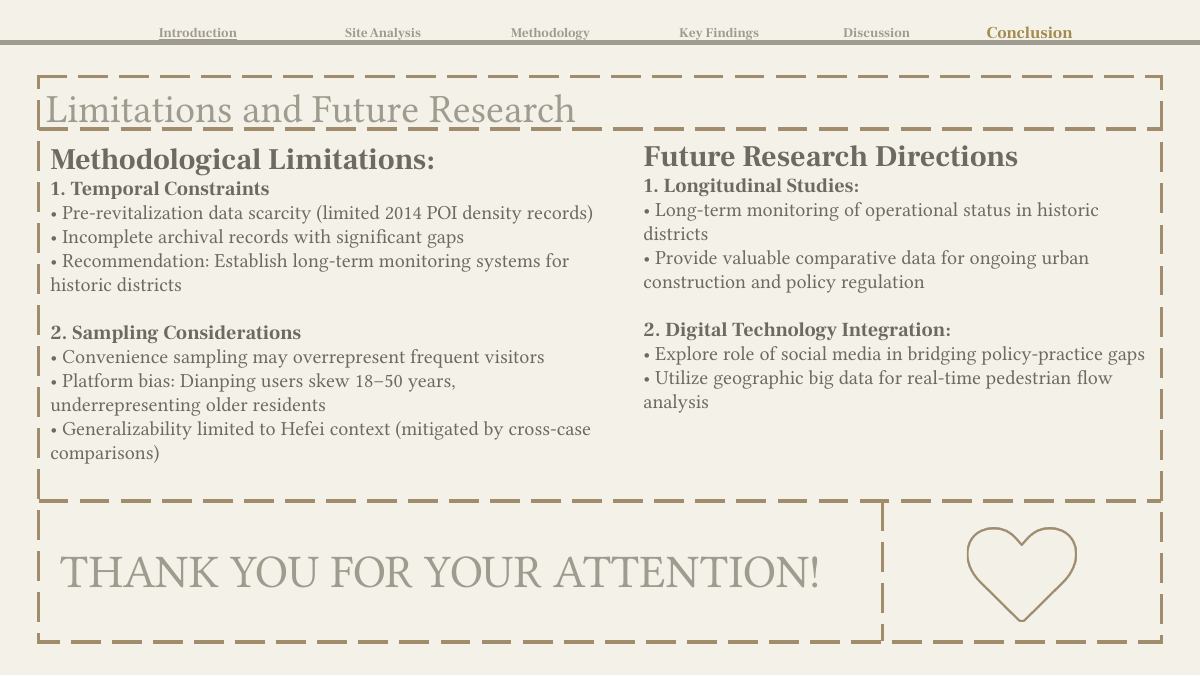
I stated four limits explicitly: gaps in pre-revitalization records, convenience sampling, age bias in Dianping data, and the limited generalizability of a single primary case. Triangulation and cross-case comparison helped, but they did not remove those constraints. The next academic step would be longitudinal monitoring that combines repeated stakeholder research with more reliable pedestrian and geographic data. For professional practice, the implication is equally important: evaluation should continue after construction, because the cultural, social and economic effects of revitalization unfold over time.
Outcome & reflection
Why this project matters
The project shows my ability to take an ambiguous real-world question from research design to evidence collection, analysis, visual communication and actionable recommendations. Academically, it offers an adaptable framework for evaluating revitalization beyond physical appearance; professionally, it demonstrates that I can connect policy, place data and stakeholder experience while stating the limits of the evidence clearly.