Course Assistant · Programme operations & bilingual communication · Langtou, Guangzhou · 2026
From Programme Delivery to Heritage Strategy: The Langtou Short Course
End-to-end delivery support for a four-day, multi-institutional heritage course, connecting participant administration, bilingual content, visual materials, onsite operations, evaluation and documentation into one coherent learning experience.
01
Overview
Context and purpose
“Revitalizing Historic Urban and Rural Landscapes through Heritage-based Solutions: Lessons from Langtou, China” was a professional short course jointly delivered by institutions including the University of Hong Kong, Tongji University / WHITR-AP and the Hong Kong Institute of Architectural Conservationists. Two online sessions and two days of onsite learning connected HUL with tangible and intangible heritage, nature-culture landscapes, the SDGs, climate action and digital transformation. My contribution was to translate this multi-partner programme into accurate, consistent, operational and reusable deliverables across preparation, onsite delivery, evaluation and documentation.
My contribution
What I was responsible for
- 01
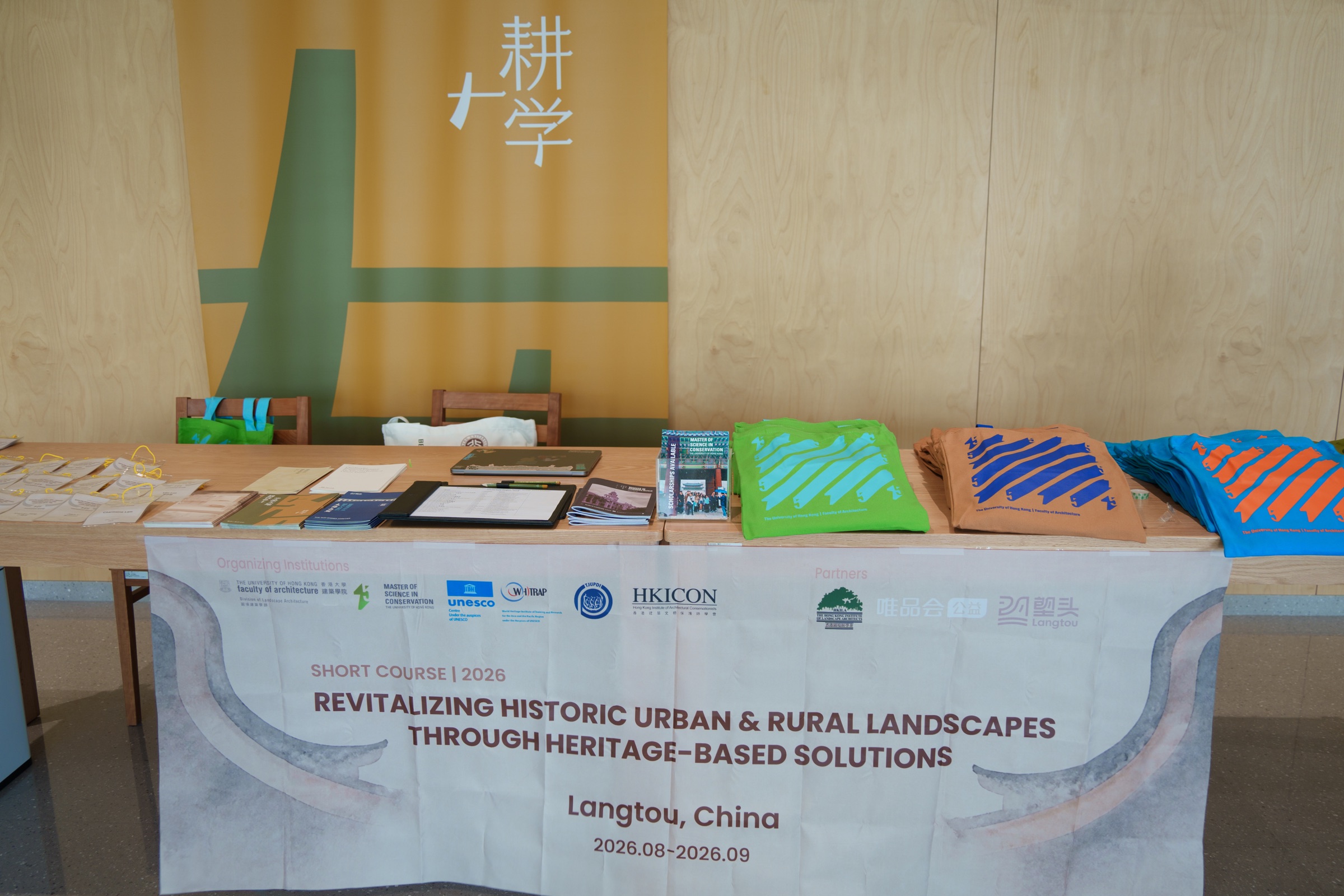
Prepared and proofread workshop administrative documents, designed and produced event materials including course banners, participant name badges, certificates of attendance and acknowledgement to support on-site operations and administrative management.
- 02
Produced or refined the course banner, editable badges, group displays, attendance records, attendance and appreciation certificates, expense-claim forms and speaker-honorarium documents for direct onsite and administrative use.
- 03
Converted heritage documentation of Langtou Village into the bilingual version, retaining the original sequence, images and narrative structure.
- 04
Coordinated end-to-end event workflows, managing registration communications, on-site check-in and participant liaison, and facilitating transitions between lectures, field visits, group assessments, expert feedback sessions and individual presentation of outcomes.
- 05
Developed applied research on living heritage and tourism governance in Hongcun, translating HUL, 3P and SDG frameworks into a strategic proposal for another World Heritage Site.
02
Process & evidence
Balancing accuracy, readability and layout in bilingual translation
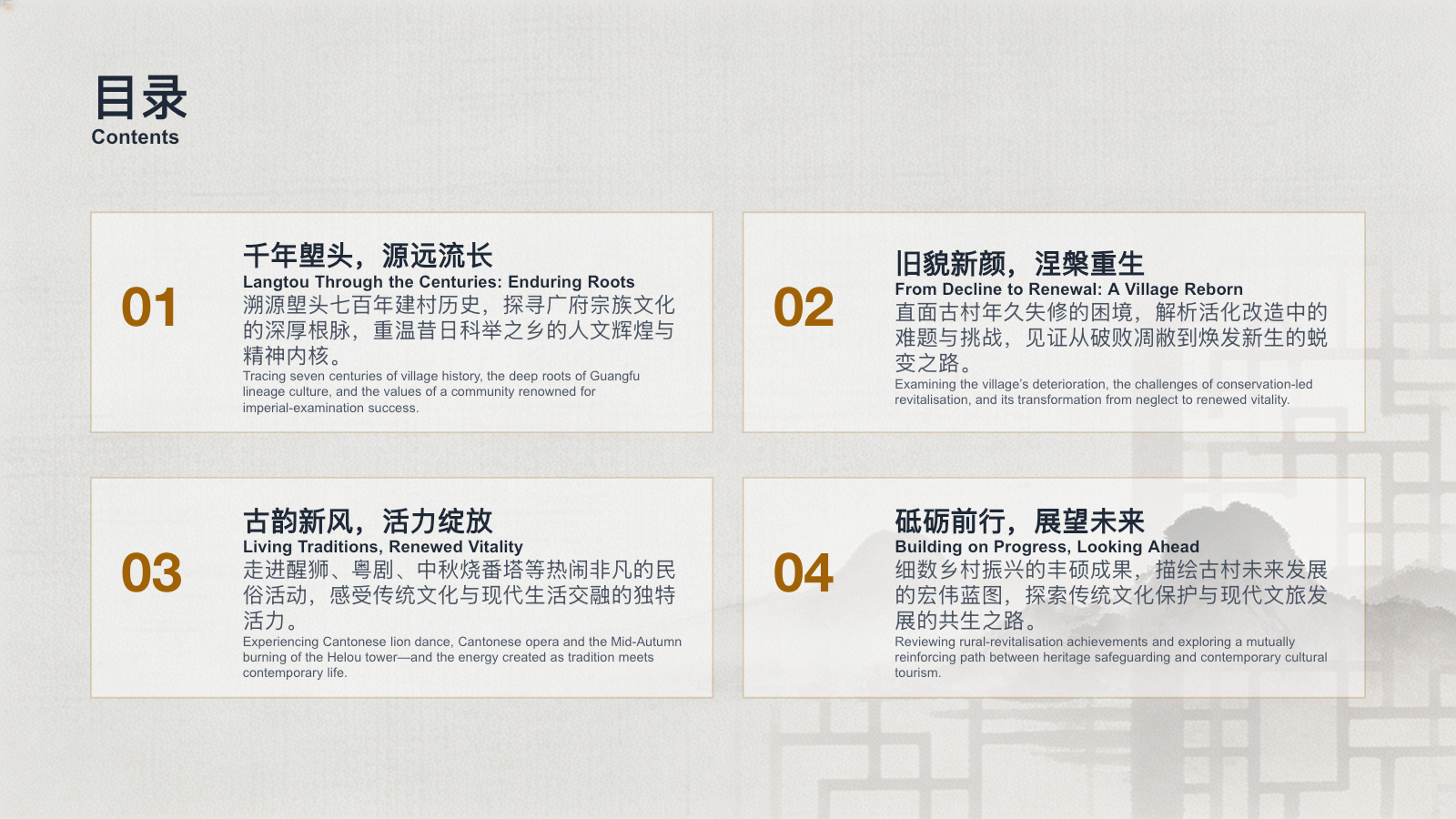
The Langtou presentation covered village history, lineage structure, living traditions, rural hollowing-out, historic buildings, philanthropy and economic information. Producing the bilingual version required decisions about cultural explanation, sentence structure and legibility within the existing composition. I edited 119 visible text frames across 18 slides and prepared bilingual speaker notes, retaining the original slide count, sequence, images and narrative structure while standardising project terminology. The result made local knowledge usable by an international audience without obscuring source authorship.
03
Process & evidence
Making the site visit part of the learning process
The onsite programme connected lectures, the Chun Yang Tai visit, a village walk, small-group reflection, resilience assessment and presentations within one continuous process. Participants had limited time to understand the place and translate observations into judgements structured around People, Planet and Prosperity. I supported registration, participant coordination, material preparation and transitions between activities, helping turn the route, observation themes and group arrangements into information that different disciplines could use quickly.
04
Process & evidence
Extending programme delivery into heritage strategy
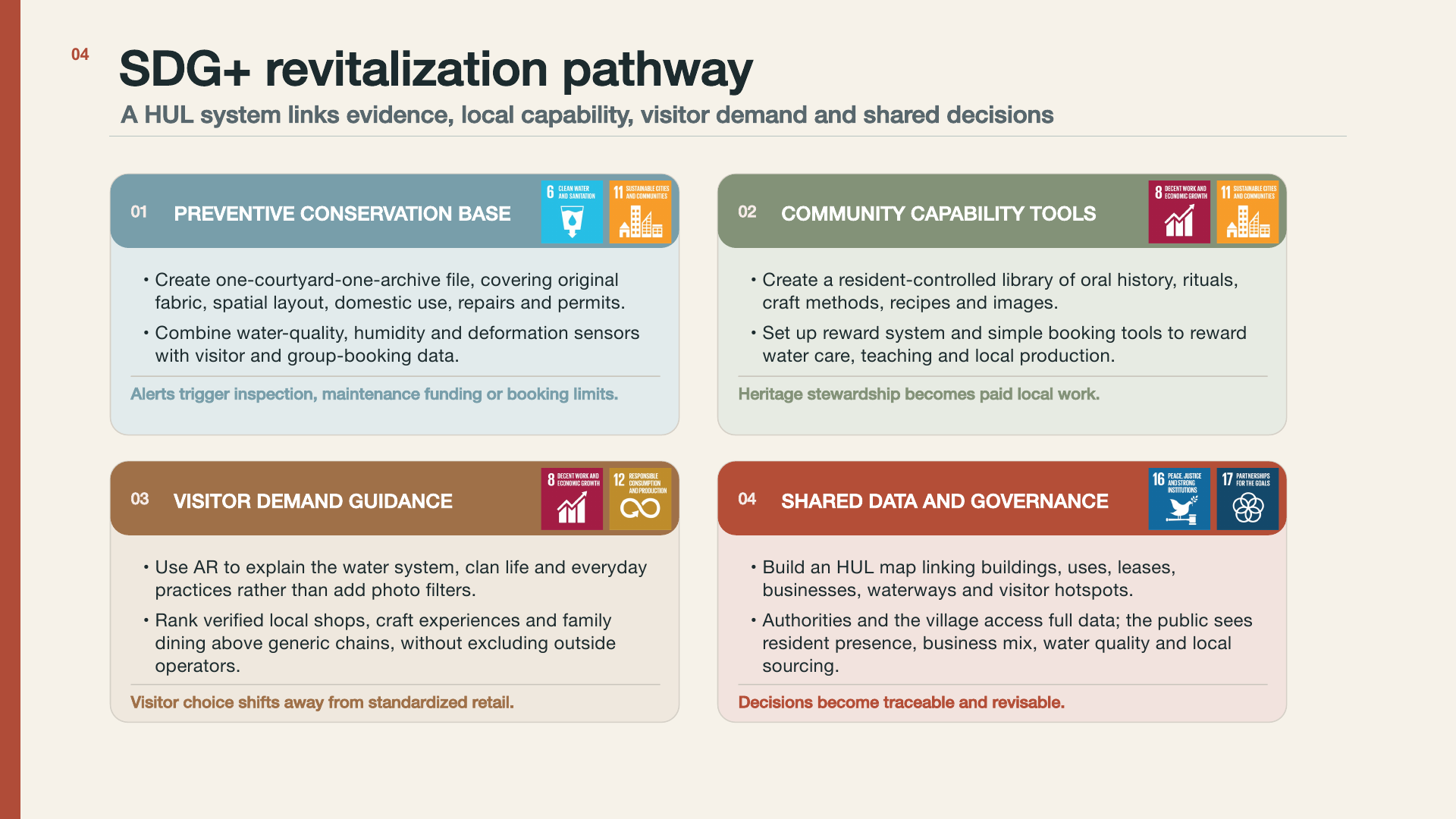
Alongside my delivery role, I completed an individual application project on Hongcun, interpreting the World Heritage village as a living system of water, homes, residents, livelihoods and governance. I identified commercial homogenisation and tourism gentrification as the challenge threatening residential continuity, then proposed connected modules for preventive conservation, community capability, visitor-demand guidance and shared governance. Indicators were linked to management responses such as inspection, maintenance funding, booking limits and impact review. The work remained a course-stage concept and was not implemented.
Outcome & reflection
Why this project matters
This project demonstrates my ability to work between professional knowledge and practical delivery: engaging with HUL, living heritage and sustainable-development frameworks while translating complex, multi-stakeholder requirements into clear documents, workflows, visual materials and learning experiences.