Beijing 798 Art District · Industrial-heritage renewal
Urban Issues & Spatial Research
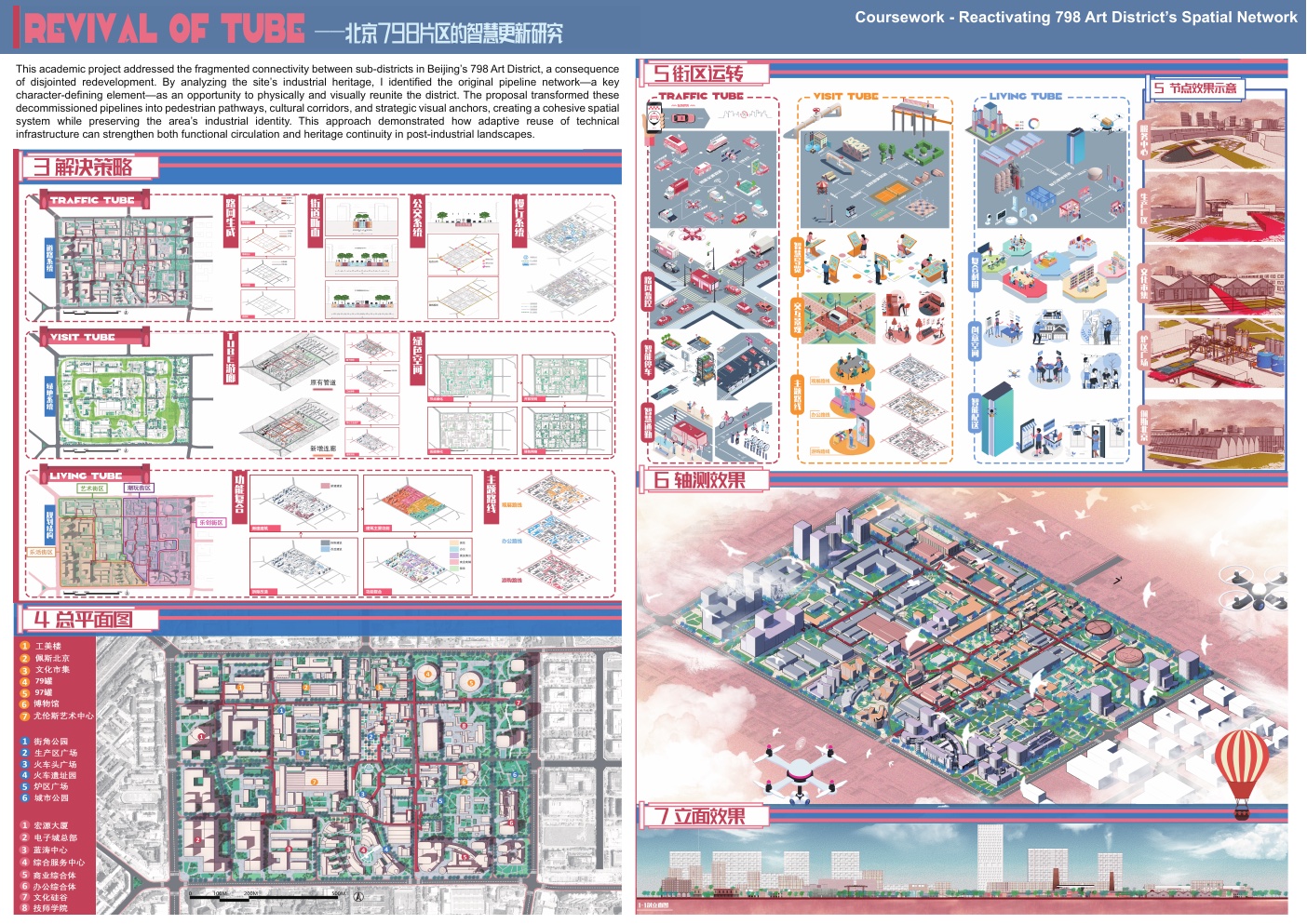
A spatial research and renewal proposal for Beijing 798, translating layered urban analysis into a clear connective strategy for movement, heritage and everyday use.
01
Overview
Context and purpose
This study examined how Beijing 798 could improve spatial continuity while retaining its industrial character. I helped organise evidence across land use, circulation, visitor experience and open space, then translated the diagnosis into a three-part renewal framework. The work demonstrates my ability to turn complex site information into a focused planning narrative, a coherent spatial strategy and clear visual communication.
My contribution
What I was responsible for
- 01
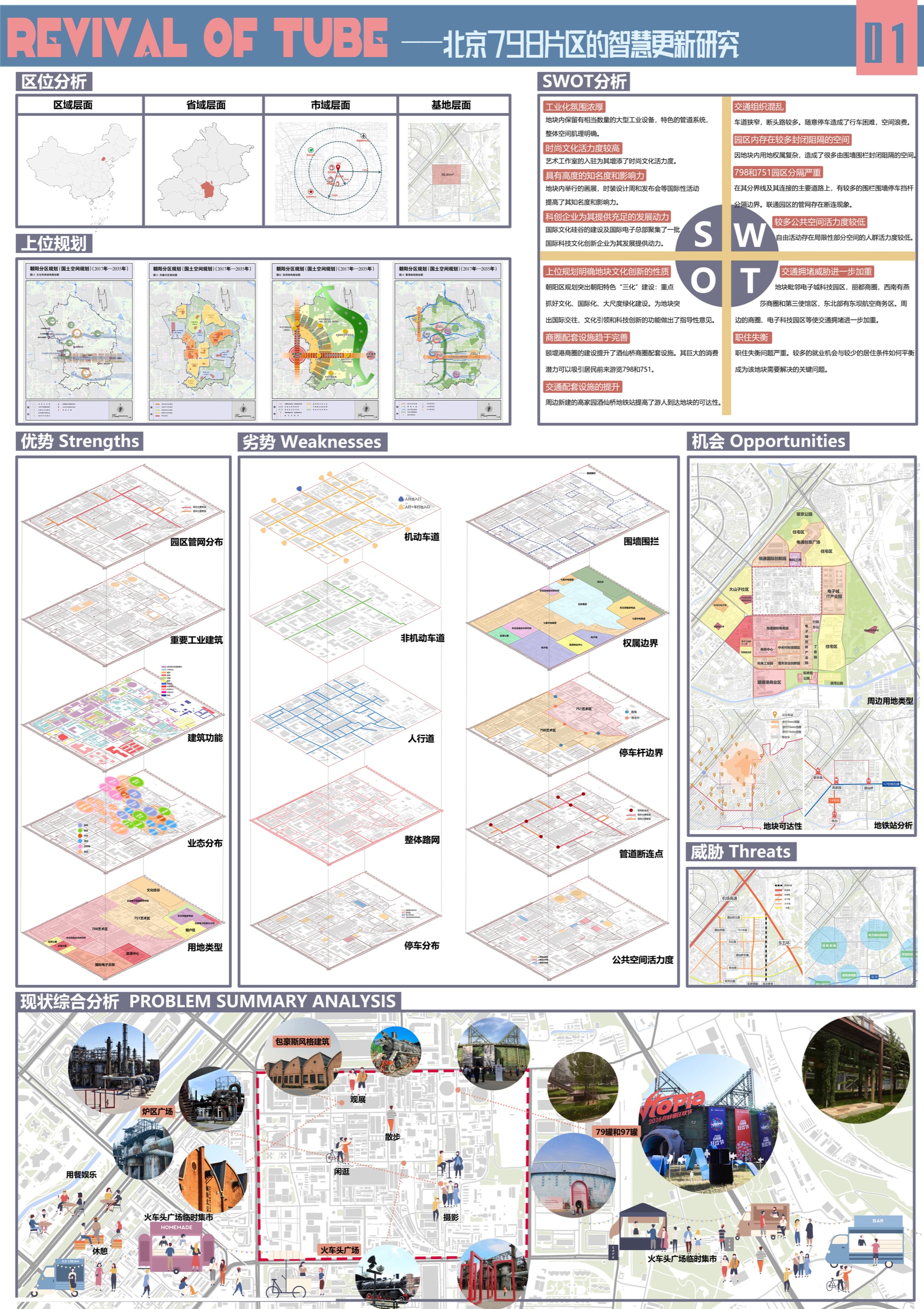
Built a layered site diagnosis covering land use, building functions, circulation, industrial infrastructure and public-space activity.
- 02
Synthesised the findings into four connected challenges: fragmented roads, functions, visitor routes and ecological space.
- 03
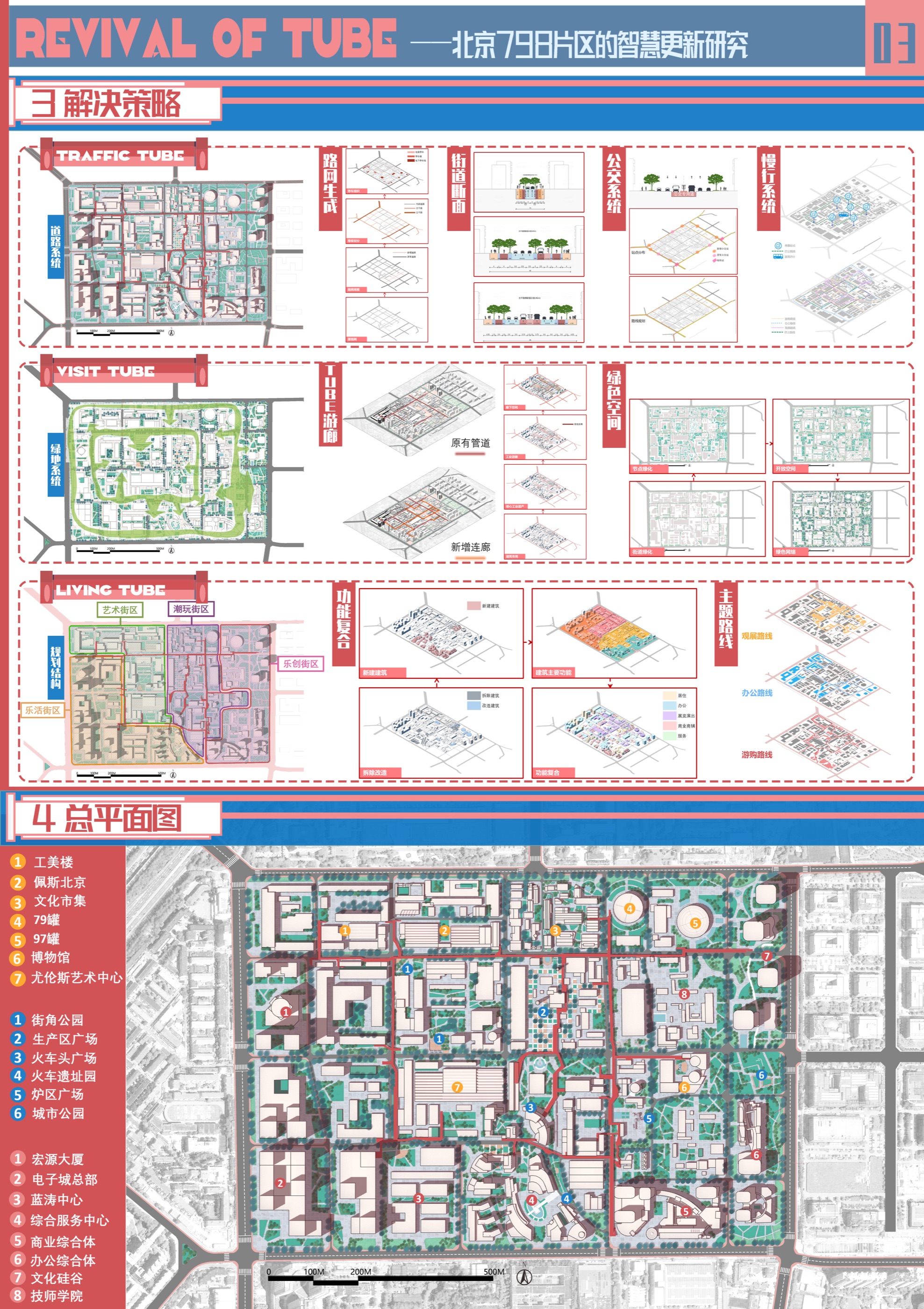
Co-developed the “Traffic Tube / Visit Tube / Living Tube” framework to reconnect movement, heritage interpretation and everyday activity.
- 04
Translated research and strategy into a concise set of analytical diagrams, system maps and a revised spatial plan.
02
Process & evidence
Beijing 798: Reading the district as layered networks
The research read 798 as a network rather than a collection of individual heritage buildings. Layered mapping brought together industrial structures, land use, businesses, roads, pedestrian routes and public-space activity. The analysis distilled this complexity into four connected breaks: circulation, function, visitor orientation and ecology.
03
Process & evidence
From four breaks to three “tubes”
The proposal used three connective systems instead of wholesale redevelopment. “Traffic Tube” clarified movement; “Visit Tube” linked cultural and industrial destinations through routes and green space; and “Living Tube” introduced programmes that support everyday use. Together, they turned the site’s industrial language into an organising framework for renewal.
Outcome & reflection
Why this project matters
The project established a traceable path from layered evidence to an integrated renewal strategy. Its central lesson is that industrial heritage can function not only as a preserved backdrop, but as an active framework for movement, orientation and everyday public life.